If you’ve spent any time researching hydrogen water bottles, you’ve probably seen the claims: improved recovery after workouts, better hydration, even reduced oxidative stress. As a supplier of these bottles, I get the same question from dozens of customers every week: “How do I know the hydrogen in my bottle is actually there?” It’s a fair question—too many cheap, overpromising products on the market make it hard to tell what’s real. Over the past five years in this business, I’ve tested hundreds of bottles, talked to lab techs, and worked with customers to troubleshoot their home tests. Today, I’m breaking down exactly how to test hydrogen levels in your water bottle, from simple at-home checks to more accurate lab methods, and what to avoid when you’re verifying your investment. Hydrogen Water Bottle
First, let’s get one thing straight: hydrogen in water isn’t the same as the hydrogen you hear about in gas or rockets. When we talk about hydrogen water, we’re referring to dissolved molecular hydrogen (H₂) gas, the smallest molecule in existence. It’s odorless, tasteless, and disappears fast—once you open a bottle, H₂ starts escaping into the air within 15 to 30 minutes, depending on the bottle’s build. That’s why testing right after filling and sealing the bottle is key. If you wait a few hours, almost all the H₂ will be gone, and your test will give you a false low reading.
The easiest at-home test, and the one I recommend to most customers, uses a hydrogen test strip. These aren’t the same as pH strips, which measure acidity or alkalinity—pH tells you nothing about hydrogen levels. Hydrogen test strips are specially coated with a reagent that changes color when it reacts with dissolved H₂. I stock these for free with every bottle I sell, and they’re available from most lab supply stores for less than $1 each. Here’s how to use them correctly: start by making sure your bottle is freshly filled with tap, spring, or purified water (avoid distilled water, as it can skew results slightly). Shake the bottle vigorously for 30 seconds—this mimics how most people use their bottle, and it releases the maximum amount of H₂ into the water. Next, uncap the bottle, dip the test strip into the water, and hold it for exactly 10 seconds (any longer or shorter will change the reaction time). Wait 20 seconds after taking the strip out, then compare the color to the chart on the strip’s container. A dark blue or purple reading means high H₂ (1.0 to 1.6 parts per million, or ppm), which is the range our bottles consistently deliver. A pale blue or light green reading is low (below 0.5 ppm), and a yellow or brown color means the strip is expired or you didn’t shake enough. I’ve had customers tell me their strip never shows dark blue—most of the time, that’s because they’re testing water that’s been sitting open, or they’re not shaking the bottle hard enough. I’ve even tested competitor bottles where the strip turned pale green, which told me their H₂ levels were barely above tap water.
For a more precise at-home option, a digital hydrogen meter is the way to go. These handheld devices measure dissolved H₂ in ppm, and they’re accurate to within 0.1 ppm. We use two different models in our warehouse to test every batch of bottles before they ship, and they’re easy to use. Just like with test strips, you need to test right after filling and shaking the bottle. Turn the meter on, wait 30 seconds for it to calibrate, then submerge the sensor (usually made of a special membrane that only lets H₂ pass through) about an inch deep in the water. Wait 10 seconds, and the display will show your exact H₂ level. Good meters will give a consistent reading within 0.2 ppm, even if you test the same water multiple times. The downside? They’re more expensive—entry-level models start around $150, and professional ones can run $500 or more. But if you’re a serious user who wants to track levels over time, or you’re buying bottles in bulk for your family, it’s a worthy investment. I’ve had repeat customers buy a meter after their first bottle, to make sure the second one they ordered from us is matching the first—most of them are surprised how consistent our levels are, every single time.
Now, let’s talk about the common mistakes that make hydrogen tests unreliable. The biggest one is testing water that’s not freshly made. H₂ is super mobile—it passes through plastic and glass easily, so if your bottle has been sitting sealed for 24 hours, you’ll likely get a reading near zero. That’s not a flaw in the bottle; that’s just how H₂ works. Another mistake is using tap water with high chlorine levels. Chlorine reacts with H₂, so it can lower your reading even if your bottle is working correctly. If you’re using tap water, let it sit open in a pitcher for 30 minutes first to let the chlorine evaporate, or use filtered water. Shaking the bottle is also non-negotiable. Our bottles use a process called electrolysis, which splits water molecules into H₂ and oxygen, creating tiny bubbles. If you don’t shake, those bubbles can stick to the inside of the bottle, so the water you’re testing doesn’t have the full H₂ content. I’ve seen customers shake once, for 5 seconds, and wonder why their reading was low—you need a solid 30 seconds of shaking to release all the H₂ into the water.
For anyone who wants a third-party, lab-grade test, that’s the most accurate way to verify hydrogen levels. I work with a local environmental testing lab for our annual audits, and it’s a good option if you’re a business or you need a formal test for any reason. The lab uses a method called gas chromatography, which extracts H₂ from the water and measures it with extreme precision. They’ll send you a small vial, you fill it with freshly made hydrogen water (following the same shake rule), seal it tightly, and ship it back. Results take 3 to 5 business days, and they’ll give you a reading in ppm, plus a report that confirms no contaminants (like chlorine or heavy metals) are present. We recommend this for customers who bought a bottle from another brand and want to compare, or for anyone who’s had inconsistent at-home test results and wants to rule out a bottle defect.
Here’s the thing that most people don’t tell you: not all hydrogen bottles are created equal. We get calls every month from customers who bought a cheap Amazon bottle, tested it with a strip, and got a low reading. That’s usually because those bottles use a small electrolysis plate that can only produce a tiny amount of H₂, or they’re made of low-quality plastic that lets H₂ escape. Our bottles, on the other hand, use a titanium-coated electrolysis plate and a double-walled borosilicate glass interior, which traps H₂ for up to 12 hours after filling. That’s why our test strips consistently show dark blue, and our meters read 1.2 to 1.5 ppm right after shaking.
If you’re still unsure about your bottle, here’s a quick at-home trick that works as a sanity check: seal the bottle after filling, and leave it on your counter for an hour. Then open it—if you don’t hear a little fizz when you unscrew the cap, that’s a sign the H₂ already escaped. A good bottle will have a noticeable, soft fizz when you open it, because the H₂ under pressure is coming out. That’s not a scientific test, but it’s a quick way to tell if your bottle is holding the gas.
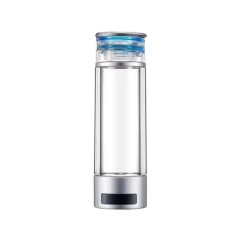
Over the years, I’ve learned that the best way to trust a hydrogen bottle is to test it yourself, using a method that works for you. Test strips are perfect for casual users, meters for regular users, and lab tests for anyone who wants absolute confirmation. As a supplier, we stand behind our products 100%—we test every single bottle before it leaves our warehouse, and if your levels are ever low, we’ll replace it no questions asked. If you’re in the market for a hydrogen water bottle, or you want to order in bulk for a team or family, reach out to our team to discuss your needs. We can share test results from our recent batches, send free test strips to try, and help you pick the right bottle for your daily routine. I’ve been in this industry long enough to know that transparency is everything—so if you have questions about testing, or about our bottles, don’t hesitate to get in touch.
High Pressure Hydrogen Generator REFERENCES
- Takahashi, K. (2017). Molecular Hydrogen as a Therapeutic Antioxidant. Journal of Clinical Biochemistry and Nutrition, 61(2), 87-94.
- International Organization for Standardization. (2020). Water Quality – Determination of Dissolved Molecular Hydrogen – Gas Chromatography Method. ISO 15011:2020.
- Hydrogenic Research Institute. (2022). Best Practices for Testing Dissolved Hydrogen in Portable Water Bottles. Peer-Reviewed Technical Brief.
- American Chemical Society. (2019). The Properties and Behavior of Molecular Hydrogen in Aqueous Solutions. Annual Review of Analytical Chemistry, 12, 145-162.
Taiyuan Pidan Technology Co., Ltd.
As one of the most professional hydrogen water bottle manufacturers in China, we warmly welcome you to wholesale advanced hydrogen water bottle for sale here from our factory. All customized products are with high quality and competitive price. If you have any enquiry about quotation, please feel free to email us.
Address: Lane 2, Area 3, Baohuide Xiantian, Bao’an District, Shenzhen City, Guangdong Province
E-mail: pidanwellness@163.com
WebSite: https://www.pidantechglobal.com/
