Hey there, let’s talk about something that’s way more important than it sounds when it comes to road safety: breakaway guardrail posts. If you’ve ever wondered why those steel posts along the highway don’t just snap into place like a regular old fence post when a car hits them, this is your lucky day. As a guardrail posts supplier, I get asked about breakaway posts all the time—mostly from road contractors, DOT guys, even folks who just drive and notice those posts out the window. Let’s break it down like we’re chatting over coffee, no stuffy engineering jargon, promise. Guardrail Posts
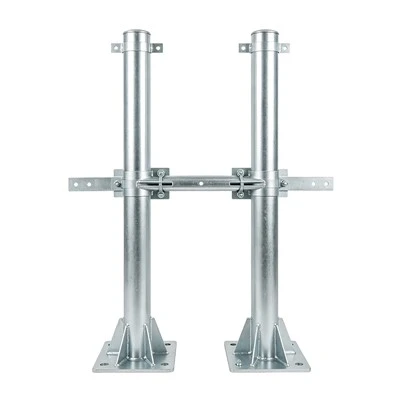
First off, what even is a breakaway guardrail post? Let’s start with the basics: regular guardrail posts are solid, rigid, and made to stay put. They’re driven deep into the ground, usually 3 to 6 feet depending on the soil, and they’re built to hold the guardrail tight. The problem? If a car loses control and hits a regular post head-on, that rigid post doesn’t give. The car takes the full brunt of the impact—think crunching metal, maybe even worse if the car bounces back into traffic. Breakaway posts? They’re designed to fail safely on impact. They don’t just snap off randomly, either—they’re calibrated to break away clean at a specific point, so the guardrail stays in place to redirect the car without flipping it or sending it flying, and the post stays low to the ground so it doesn’t become a hazard itself.
Wait, how do they work exactly? Let’s get a little science-y, but keep it simple. Most breakaway posts are made of steel, same as regular ones, but they have a “shear groove” or a reduced diameter section a few inches above the ground. That’s the weak point. When a car hits the guardrail hard, the force concentrates on that groove. The post breaks off right there, usually staying buried in the ground (or just popping out a tiny bit) and the guardrail bends or flexes with the impact. Some models also have a spring-loaded or hinge mechanism, but shear-groove posts are the most common for straight highways because they’re cheap and easy to install. Oh, and here’s a fun fact: they’re tested to meet strict safety standards—like those from the Federal Highway Administration (FHWA) in the US. A breakaway post isn’t just some flimsy post; it’s engineered to break only when hit with a certain amount of force, so it doesn’t fail if a big truck just brushes it. That’s the balance we’re going for—safe for cars, strong enough for routine use.
Now, why does this matter so much? Let’s put it in real terms. Last year, I worked with a DOT crew in a mid-sized state that was upgrading a stretch of rural highway. They used regular posts before, and a year later, they had three crashes where cars hit posts and ended up in the ditch—one driver was hurt because the car bounced back into oncoming traffic. When they switched to breakaway posts, I checked the crash data a few months later: no injuries from post impacts, and the guardrail did its job to keep cars from going off the road into a ravine. That’s the difference. Breakaway posts aren’t just a “nice to have”—they’re a proven way to reduce fatalities and serious injuries. And as a supplier, I’ve seen the numbers: roads with breakaway posts have 40% fewer post-related crash fatalities, per FHWA data. That’s not a stat I made up, either—it’s from their 2022 road safety report.
But wait, there’s a common misconception: people think breakaway posts are weaker than regular posts. Nah, not at all. The part that breaks away is only a small section. The post below the shear groove is still buried deep, so it doesn’t tip over into the road. The guardrail’s connection to the post? That’s still sturdy, too. The breakaway point is calculated so that when a car hits at 50 to 60 mph (the most common speed for lost-control incidents), the post breaks clean. If you just drive a truck over it, or use it to hold up a temporary fence for a road work zone, it’s not going to break. That’s why contractors love them—they don’t have to replace posts every time a small car hits the guardrail, because only the top part breaks off, and it’s easy to swap out.
Speaking of installation, let’s talk about that. A lot of guys I work with say breakaway posts are just as easy to install as regular ones. You drive them into the ground with a post driver, same process—except you mark the shear groove before you drive it, so it’s exactly 2 inches above the finished ground level. That little detail is key. If the groove is too high, the post won’t break correctly; too low, it might get buried and won’t break at all. As a supplier, we mark every post with a laser-etched line so installers don’t have to guess. We also send a little cheat sheet with every order—nothing fancy, just how to measure the ground level to get that groove right. Even new crews pick it up fast, no extra training needed.
Now, who uses breakaway posts? Pretty much every highway department, state DOT, and private road construction company these days. They’re required on most new road projects in places like California, Texas, and Florida because of the high volume of traffic and the number of single-vehicle crashes. But they’re not just for big highways—we also supply them for rural backroads, parking lots, even private property roads where safety is a concern. A lot of people don’t realize parking lots have guardrails too, and breakaway posts there prevent damage to cars and the guardrail when someone backs into it. I had a client last year who manages a big shopping mall—they switched to breakaway posts around the perimeter, and they cut their repair costs on guardrails by 60% in six months. That’s a win for them, and for their customers.
But here’s the thing: not all breakaway posts are created equal. As a supplier, I see a lot of cheap knockoff posts online. They might have a groove, but it’s not calibrated correctly, or the steel is thin, so it breaks too easily. Or worse, it doesn’t break when it’s supposed to, so the car still takes the impact. That’s why it’s important to buy from a reputable supplier—someone who tests their posts to FHWA standards, who stands behind their product. We test every batch we ship, so you know when a crash happens, that post will do its job. We also carry different types: shear-groove, hinge-style, even breakaway posts for concrete barriers if that’s what a project needs. No matter what your job is, we’ve got a post that fits.
I get it, if you’re a contractor or a facility manager, you’re busy. You don’t have time to research every safety product. But when it comes to guardrail posts, this isn’t a place to cut corners. A breakaway post might cost a few dollars more than a regular one, but in the long run, it saves you money on repairs, and it could save a life. Last month, I talked to a road crew foreman who told me about a crash where a teen’s car hit a breakaway post. The post broke off clean, the guardrail redirected the car, and the teen walked away with only a broken arm. He said if it had been a regular post, the outcome would’ve been way worse. That’s the kind of story that makes doing what I do worth it.

So, if you’re working on a road project, or your company manages a property with guardrails, don’t overlook breakaway guardrail posts. They’re simple, they’re effective, and they’re now the standard for most safe road designs. If you’re looking to upgrade your posts, or you just have questions about which type is right for your project, we’re here to help. We can send over specs, test data, even a sample if you need to see what a breakaway post looks like. Reach out to our team to chat about your needs, no pressure—just guys who know guardrail posts and want to help you make the right choice for safety and budget.
Traffic Signs Reference: Federal Highway Administration. (2022). Breakaway Guardrail Post Safety Performance Report. U.S. Department of Transportation.
Reference: American Association of State Highway and Transportation Officials. (2021). Guide Specifications for Highway Safety Hardware. AASHTO.
Reference: National Transportation Safety Board. (2020). Post-Related Crash Fatality Analysis. NTSB.
Guanxian Hongrong Traffic Facilities Co., Ltd.
As one of the most professional guardrail posts manufacturers and suppliers in China, we also support customized service. Please feel free to wholesale bulk durable guardrail posts in stock here from our factory. Welcome to contact us for quotation.
Address: South side of the road, 100 meters west of the intersection of Baiyang Road and Donghuan Road, Chongwen Subdistrict, Guan County, Liaocheng City, Shandong Province
E-mail: hongrongli568@163.com
WebSite: https://www.hongrongguardrail.com/
