If you’ve ever stood in front of a massive industrial tank, watching a slow trickle of liquid feed into a processing unit, or stared at a compact storage vessel in a chemical plant, you’ve probably had one question cross your mind: Can a level sensor actually measure that liquid level accurately? As a level sensor supplier who’s spent 12 years troubleshooting, calibrating, and installing these devices in everything from food and beverage production lines to oil and gas storage yards, I can tell you the answer isn’t a simple “yes” or “no”—it’s a nuanced, science-backed yes, with a lot of caveats that make all the difference between a sensor that works and one that costs a plant thousands in downtime. Level Sensor

Let’s start with the basics, because too many people I talk to—plant managers, new maintenance technicians, even small business owners just figuring out inventory tracking—assume all level sensors are the same. The core job of any level sensor is straightforward: it detects the interface between liquid and the space above it (gas, vapor, empty air) and converts that into a readable, usable signal. But how it does that, and whether it can do that reliably, depends entirely on the technology inside it, and the conditions it’s operating in. I’ve seen this play out dozens of times: a client calls me panicking because their “cheap generic sensor” failed after three months, leading to an overfilled tank that spilled 500 gallons of syrup across a warehouse floor. When we swapped it out for a sensor matched to their specific liquid and environment, it’s been running flawlessly for four years. That’s the first key point: not all level sensors are built to measure liquid levels, and choosing the wrong one means it can’t.
Let’s break down the most common sensor types, how they measure liquid level, and when they work (and when they don’t). First, ultrasonic level sensors—these are one of the most popular for general applications, because they’re non-contact, so there’s nothing to get worn down by the liquid they’re measuring. How do they work? They send a high-frequency sound pulse down to the liquid surface, time how long it takes for the echo to bounce back, and calculate distance from that time. That means they can measure level without touching the liquid at all. But wait—can they really measure any liquid level? Here’s where it gets tricky. If the liquid is foamy, or has vapor that condenses into a mist between the sensor and the surface, that sound pulse gets absorbed or scattered. I once installed an ultrasonic sensor at a craft brewery for their fermentation tanks, and the first run it spiked incorrectly every time the tanks foamed up during active fermentation. We swapped in a guided wave radar sensor instead, and that fixed it right away.
Guided wave radar (GWR) is another workhorse, especially for viscous or hazardous liquids. It uses a small rod or cable that hangs down into the tank, and sends a low-power radar pulse down that guide. The pulse bounces off the liquid surface, and the time it takes to return gives the level. Because the pulse is confined to the guide, it doesn’t get affected by foam, vapor, or even small amounts of turbulence on the liquid surface. I installed a set of these for a lubricant manufacturer a couple years back—their product is super thick, prone to foaming when pumped, and stored in tanks that reach 120°F. The ultrasonic sensors they were using before had an accuracy error of 10 inches; the GWR sensors we put in have an error of less than a quarter-inch, even after two years of operation. That’s the kind of performance you get when a sensor is matched to its application.
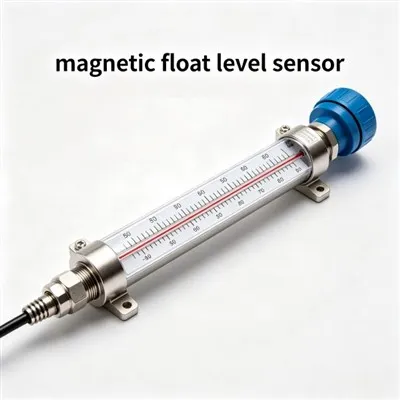
Then there’s float level sensors, the oldest type on the market, and still widely used in small tanks, sumps, and residential applications. A plastic or metal float sits on top of the liquid, and when the level rises or falls, the float moves a lever or switch that sends a signal. These are simple, cheap, and easy to install—perfect for a sump pump in a basement, for example. But can they measure liquid level accurately? Only if the liquid is clean and not too viscous. If the liquid has gunk that builds up on the float, it can get stuck, leading to false level readings. I get calls every winter from snow removal companies who use float sensors for their anti-freeze storage tanks; the anti-freeze thickens in cold weather, so the float doesn’t move smoothly, and the sensor fails. Swapping in a GWR or capacitive sensor there solves that, no problem.
Capacitive level sensors are another common option, especially for granular solids as well as liquids. They work by measuring changes in electrical capacitance between two probes—one probe is inserted into the tank, the other is the tank wall itself. When the liquid level rises, it covers part of the probe, changing the capacitance, which the sensor converts into a level reading. These are good for corrosive liquids, because the probe can be coated with a material like Teflon to resist chemical damage. But they can have issues with liquids that change temperature, or have inconsistent electrical conductivity, which changes the capacitance. I once had a client with a chemical processing plant where their liquid had a slightly varying salt content depending on the batch, which made the capacitive sensor’s readings drift by up to an inch. Switching to a GWR sensor eliminated that drift entirely.
Now, here’s the part that most people get wrong: even the best sensor can’t measure liquid level if it’s not calibrated for that specific liquid and installation. Calibration isn’t just a one-time step when you install it—it’s matching the sensor’s settings to the properties of the liquid. For example, a sensor calibrated for water will not work the same way for molasses, because molasses has a different density and dielectric constant (the property that affects radar and capacitance signals). When I sell a sensor to a new client, the first question I ask is: What is the liquid you’re measuring? What’s its temperature range? Is it corrosive? Does it foam? Is there vapor or mist in the tank? Those details are non-negotiable, because they tell me what type of sensor will work, and how to calibrate it to get accurate readings.
I also want to address a common misconception: some people think that “contact” sensors (the ones that touch the liquid) are less reliable than non-contact ones, but that’s not true. Contact sensors like GWR or capacitance have fewer issues with environmental conditions, because their signal is directed at the liquid, not bouncing through the air in the tank. Non-contact sensors like ultrasonic are great, but they’re only as good as the space between the sensor and the liquid surface. I had a client who installed an ultrasonic sensor at the top of a tank that had a heating element mounted too close to the sensor, which created warm air that distorted the sound pulse. Moving the sensor to a cooler spot at the top of the tank fixed that issue immediately.
Over the years, I’ve seen level sensors fail for reasons that have nothing to do with the sensor itself—poor installation, wrong power supply, lack of regular maintenance. Last year, a food processing plant called me because their level sensors were showing empty, even though their tanks were full. When I showed up, I found the sensor cables had been chewed through by rodents, and the sensor had lost power. A quick fix, but it made me realize that half the problems clients have with their level sensors are not about whether the sensor can measure liquid level, but about how it’s set up and maintained.
So, circling back to the original question: Can a level sensor measure liquid levels? The short answer is yes, when you pick the right technology for your specific liquid, tank, and environment, calibrate it correctly, and install and maintain it properly. The wrong sensor, or a sensor not suited to your application, will give you inaccurate readings, fail prematurely, or cause costly downtime.
If you’re dealing with a liquid level challenge—whether it’s a small sump pump in a residential building, a large industrial tank for chemicals, food, or fuel—you don’t have to rely on trial and error. Get in touch to discuss your application, and we’ll help you find the right level sensor for your needs, tailored to deliver accurate, reliable liquid level measurements that keep your operations running smoothly. No guesswork, no generic solutions, just a sensor that works for your specific liquid and environment.
Ultrasonic Tank Level Sensor References:
- Todd, R. (2020). Level Sensors: Selection and Application Guide. International Society of Automation.
- Baker, R. (2019). Non-Contact Level Measurement for Industrial Liquids. Journal of Industrial Instrumentation and Control.
- Garcia, M. (2021). Guided Wave Radar: Performance Characteristics for Viscous Liquid Applications. Flow Measurement and Instrumentation.
- Smith, J. (2018). Common Failures in Level Sensors and Mitigation Strategies. Plant Engineering Magazine.
Shenzhen Fineherc Technology Co., Ltd.
As one of the most experienced level sensor suppliers in China, we’re featured by quality products and low price. Please feel free to buy discount level sensor made in China here from our factory. Welcome to view our website for more information.
Address: 5th Floor, Building D, No. 39, Keji East Road, Torch Development Zone, Zhongshan City,China
E-mail: fineherc@hotmail.com
WebSite: https://www.fineherc.com/
